What happens when the version of yourself you perform for the world becomes the only version you have access to? A look at identity, optimization, and the cost of coherence.
.png)
The Performance of Identity: When the Self Is a Strategy
There is a version of yourself that you perform for the world. You have calibrated it over years, the right amount of warmth, the right amount of competence, the right amount of vulnerability to seem relatable without seeming unstable. You know which version to deploy in which context. You are good at it.
The question is: what is left when the performance stops?
The Sociological Frame
Erving Goffman, writing in 1959, described social life as a series of performances. We present different versions of ourselves in different contexts, what he called "front stage" and "back stage" behavior. The front stage is the performance. The back stage is where you drop the act.
Goffman's framework was descriptive, not pathological. He was not saying that performance is false and authenticity is true. He was saying that the self is, in some fundamental sense, relational, it is constructed in interaction, not prior to it.
This is a useful frame. It is also, for some people, a terrifying one.
When There Is No Back Stage
For people who have spent their lives masking, suppressing natural responses, performing neurotypical behavior, managing the gap between who they are and what the world expects, the back stage may not exist in any meaningful way.
The performance has been running so long, and so continuously, that there is no offstage self to return to. The mask has become the face. Or more precisely: the mask has been in place so long that the face underneath is no longer accessible, and it is not clear whether it still exists in the form it once did.
This is not a metaphor. It is a description of a real experience that many people have, and that most frameworks for understanding identity do not account for.
The Optimization Problem
Contemporary culture has a particular version of this problem. The language of self-improvement, optimization, productivity, personal branding, the curated self, encourages a relationship to identity that is fundamentally strategic. You are not a person; you are a project. You are not living; you are building.
This framework is seductive because it offers control. If the self is a strategy, then the self can be improved. If identity is a performance, then the performance can be refined. The anxiety of not knowing who you are is replaced by the project of becoming who you want to be.
The problem is that the project never ends. And the person doing the optimizing is also the thing being optimized. At some point, the question of who is doing the optimizing, who is behind the project, making the decisions about what to improve and toward what end, becomes unanswerable.
The Collapse
What happens when the strategy fails?
Essays like this, in your inbox
New writing on neurodivergent experience, dark fiction, and the book — no noise.
Not gradually, in a way that allows for adjustment. But suddenly, in a way that leaves the person without the tools they have been using to manage their existence.
The performance that was automatic is no longer available. The system that was holding everything together has stopped working. And underneath it, or in the space where it used to be, there is not a self waiting to be discovered. There is just the absence of the system.
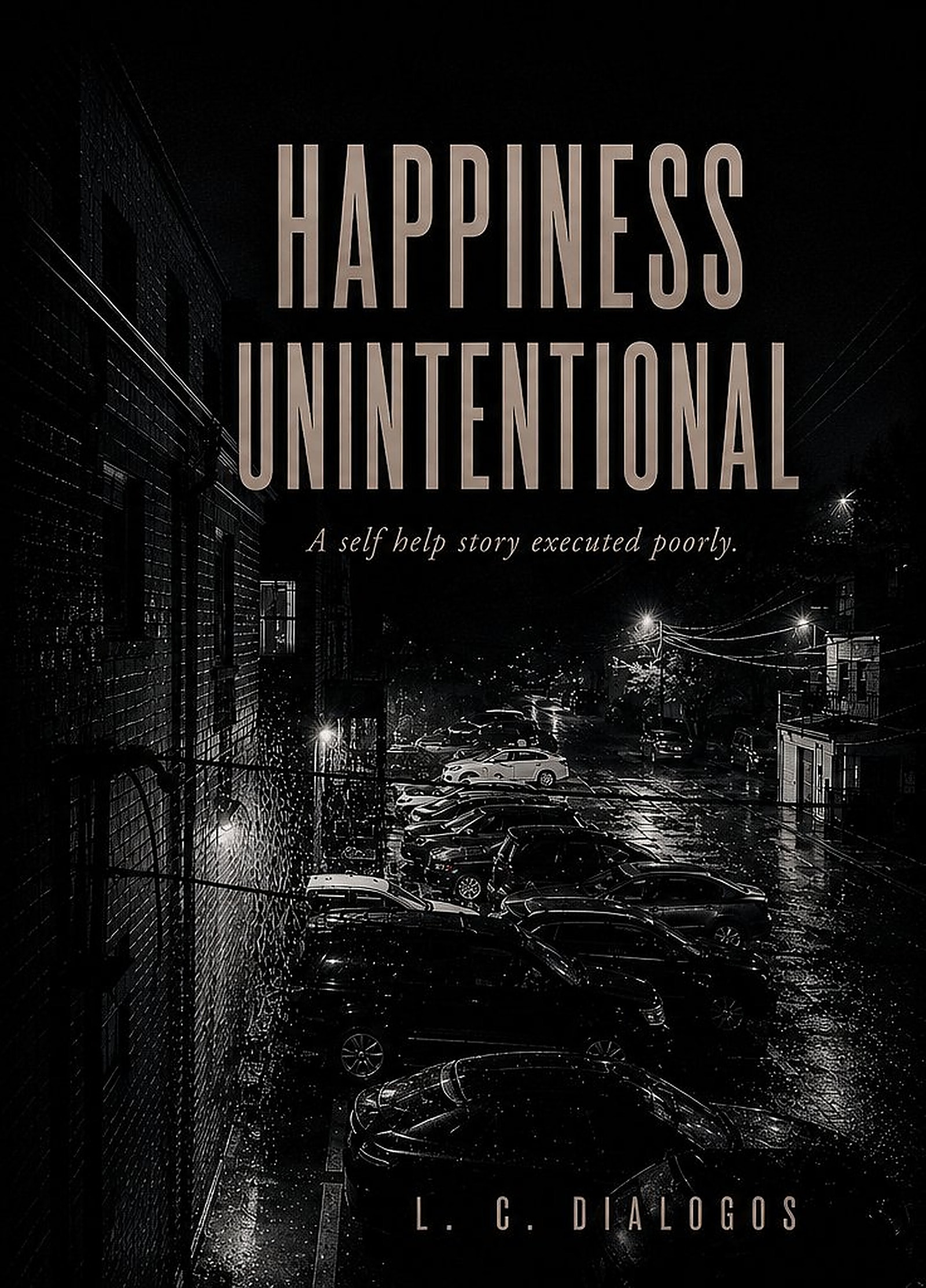
This is the territory that Happiness Unintentional inhabits. The novel is not interested in the performance itself, it is interested in the moment when the performance becomes impossible, and what is revealed in that moment.
What is revealed is not a true self, liberated at last. It is something more disturbing: the possibility that the performance was not concealing a self but constituting one. That the identity was the strategy, all the way down.
The Literary Tradition
This is not a new preoccupation. Literature has been interested in the performed self for as long as there has been literature.
Hamlet is a man who cannot find the authentic action beneath the performance. Raskolnikov in Crime and Punishment constructs an elaborate philosophical identity to justify what he wants to do, and the novel is the story of that construction collapsing. Meursault in The Stranger is a man so disconnected from the expected performance of selfhood that his failure to perform grief at his mother's funeral becomes the evidence for his guilt.
The contemporary version of this question is shaped by the specific pressures of a culture that has made self-construction both mandatory and impossible. You must have a personal brand. You must be authentic. You must optimize. You must be genuine. The contradictions are not incidental, they are the point.
What the Question Is Really Asking
The question of whether the self is a performance is not really a philosophical question. It is a question about what you are left with when the performance fails.
For some people, the answer is: a self that was there all along, waiting. The performance was protective, and removing it reveals something real.
For others, the answer is more complicated. The performance was not concealing a self. It was doing the work of selfhood. And when it stops, the work of figuring out what comes next is not a discovery, it is a construction. Slow, uncertain, and without a blueprint.
Both of these are real. Both of them are in the novel.
Read an excerpt from Happiness Unintentional, or get the book in print, ebook, or Kindle.
Further reading from the Journal:
Explore Topics
Written by
L. C. Dialogos
L. C. Dialogos writes dark psychological fiction exploring identity crisis, emotional numbness, and the anxiety of performing a self you're no longer sure exists. Influenced by Cronenberg, Lynch, and interdisciplinary frameworks spanning anthropology, neurology, and experimental literature. About the author →