
Some novels render the experience of not quite being present in your own life with more precision than clinical language ever manages. These are those books.

Books That Understand Dissociation Better Than Any Diagnosis
Dissociation is notoriously difficult to describe. The clinical definitions, depersonalization, derealization, a disruption in the normal integration of consciousness, are accurate but cold. They tell you what is happening at the level of mechanism. They do not tell you what it feels like to watch yourself from a slight remove, to move through your own life as though it belongs to someone else, to be present and absent at the same time.
Fiction, at its best, can do what clinical language cannot. It can render the texture of an experience from the inside.
These are the books that do that most precisely for dissociation.
Never Let Me Go: Kazuo Ishiguro
Ishiguro's narrators are almost always dissociated in some structural sense, they are telling you a story they do not fully understand, from a remove that is both temporal and emotional. But Never Let Me Go makes this its explicit subject.
Kathy H. narrates her own life with a quality of detachment that is not coldness. She is present. She notices. She remembers. But there is a gap between her and her own experience that she never quite closes, and the novel never explains away. The reader understands, before Kathy does, what that gap costs her.
What Ishiguro captures is the way dissociation can coexist with genuine feeling, how you can be moved by something and simultaneously watching yourself be moved, as though from a seat slightly behind your own eyes.
My Year of Rest and Relaxation: Ottessa Moshfegh
Moshfegh's unnamed narrator is trying to disappear from her own life. She is not depressed in any way she can name. She is not in crisis. She simply wants to stop being present, and she pursues that goal with the same flat efficiency she brings to everything else.
The novel is a precise rendering of a particular kind of dissociation, the kind that is not dramatic, not traumatic in any obvious way, but is instead a slow withdrawal from the experience of being a self. The narrator is not suffering visibly. She is simply not quite there.
This is the dissociation that is hardest to explain to other people, because it does not look like anything from the outside. Moshfegh renders it from the inside with uncomfortable accuracy.
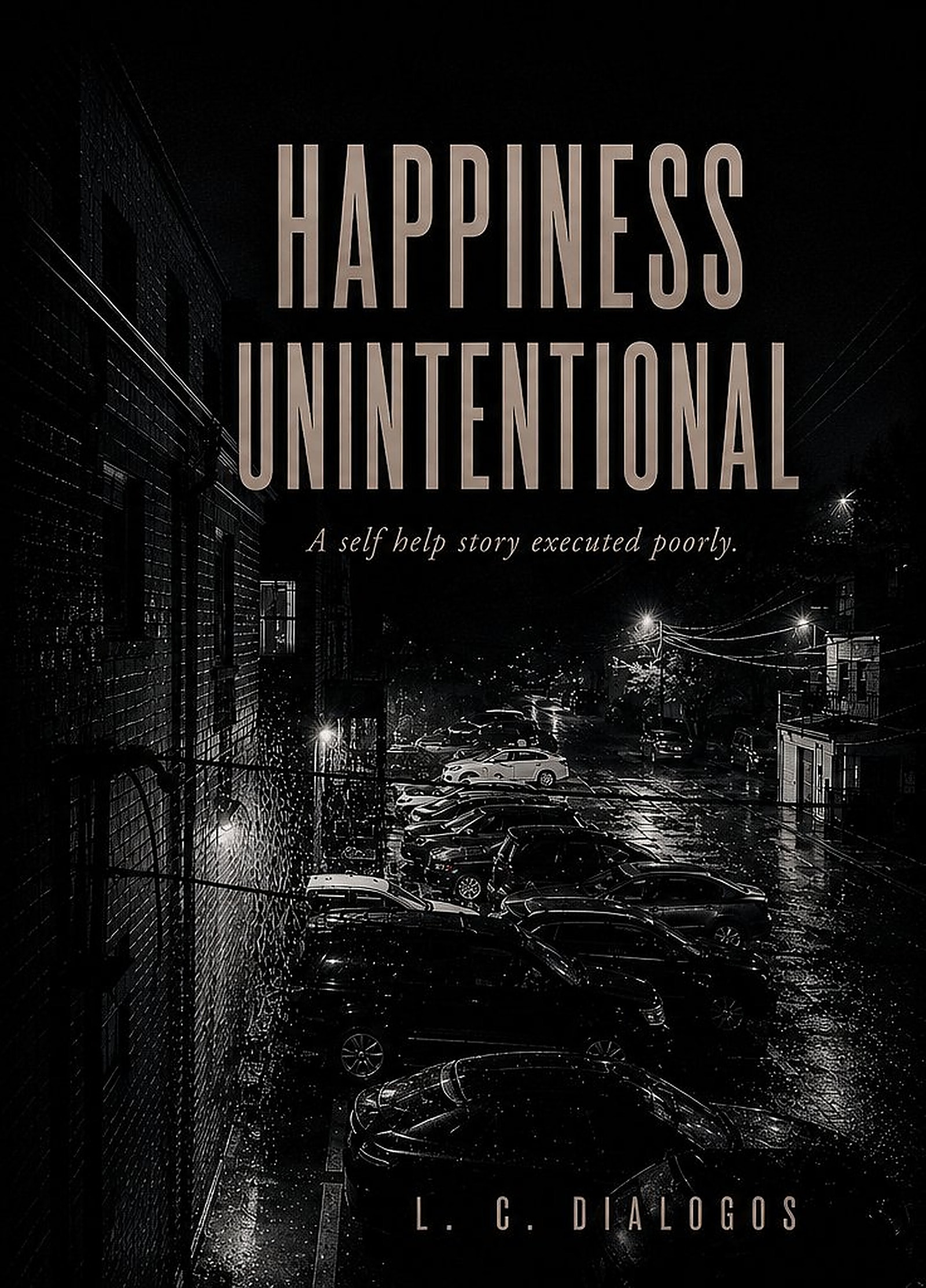
Happiness Unintentional: L. C. Dialogos
Elias does not know he is dissociated. That is the point.
He has optimized himself into a state of high function and low presence. He performs competence, connection, and contentment with such consistency that he has lost access to whatever was underneath those performances. He is not numb. He is not suffering, as far as he can tell. He is simply not quite there.
The novel follows what happens when that state becomes unsustainable, not through a dramatic crisis, but through a slow accumulation of moments in which the gap between his performed self and whatever remains of his actual self becomes impossible to ignore.
It is a book about dissociation written from inside it. The narrator does not have the language for what is happening to him. The reader does.
Readers compare it to: My Year of Rest and Relaxation (Moshfegh), Never Let Me Go (Ishiguro), The Remains of the Day (Ishiguro).
Essays like this, in your inbox
New writing on neurodivergent experience, dark fiction, and the book — no noise.
Read the first chapter free →, no sign-up. Or get the book in print, ebook, or audiobook.
The Bell Jar: Sylvia Plath
Plath's Esther Greenwood describes her depression in terms that are also, unmistakably, descriptions of dissociation: the bell jar that descends, the sense of being sealed off from the world, the experience of watching her own life through glass.
What makes The Bell Jar endure is not its clinical accuracy, it predates most of the language we now use, but its phenomenological precision. Plath knew what it felt like to be inside that state, and she wrote it without flinching and without aestheticizing it into something more bearable than it was.
Convenience Store Woman: Sayaka Murata
Murata's Keiko is not dissociated in a clinical sense. But she experiences her own interiority with a quality of distance that many autistic readers recognize immediately: she observes herself, studies others, and constructs behavior from observation rather than instinct. She is present in her life but not quite of it.
The novel is often read as a satire of social conformity, and it is. But it is also a precise portrait of what it is like to experience yourself as slightly outside the human consensus, to understand the rules intellectually while remaining uncertain whether you feel them.
What These Books Share
None of these novels explain dissociation. They do not offer frameworks or solutions. They do not resolve into clarity.
What they do is render the experience from the inside, the particular quality of watching yourself, of being present and absent simultaneously, of moving through a life that feels like it belongs to someone else, with enough precision that readers who know that experience recognize themselves in it.
That recognition is not a small thing. For many people, it is the first time they have seen their interior experience reflected accurately anywhere.
Clinical language tells you what is happening. These books tell you what it is like. Both matter. But when you are inside the experience, it is often the second kind of knowing that reaches you.
Further reading from the Journal:
- Why Neurodivergent People Are Drawn to Dark Fiction
- Dark Literary Fiction: Books That Stay With You
- On Writing a Character Who Doesn't Know They're Suffering
From the author's clinical writing: L. C. Dialogos is a novelist and licensed therapist.
Explore Topics
Written by
L. C. Dialogos
L. C. Dialogos writes dark psychological fiction exploring identity crisis, emotional numbness, and the anxiety of performing a self you're no longer sure exists. Influenced by Cronenberg, Lynch, and interdisciplinary frameworks spanning anthropology, neurology, and experimental literature. About the author →
.png)
