Mark Haddon's novel opened a door. These books walk through it: into darker, stranger, more interior territory.
.png)
If You Liked The Curious Incident of the Dog in the Night-Time, Read This
Mark Haddon's novel did something unusual when it was published in 2003: it put readers inside a mind that processed the world differently, and it did so without condescension, without a redemption arc, and without asking the reader to feel sorry for the protagonist. Christopher Boone was not a tragedy. He was a person. The novel trusted readers to follow him.
That trust, the willingness to render a different kind of interiority without explaining it away, is what made the book matter. And it is what connects it to the books below.
These are not books about autism. They are books that share The Curious Incident's core quality: the willingness to render a mind from the inside, without apology, without resolution, and without the comfort of a narrator who understands themselves completely.
Convenience Store Woman: Sayaka Murata
Keiko, like Christopher, has found a context where she functions perfectly. The convenience store has rules. The rules are clear. She follows them, and she is good at her job, and she is at peace.
Outside the store, the social world is as incomprehensible to Keiko as it is to Christopher. She does not know why people want the things they want. She does not understand the pressure to perform normalcy. She has simply adapted, found her niche, built her life around it, and learned to perform well enough to avoid the worst of the consequences.
Where The Curious Incident is about a child navigating a crisis, Convenience Store Woman is about an adult who has found a sustainable equilibrium, and about the social forces that refuse to let her keep it. It is funnier than Haddon's novel, and stranger, and in some ways more unsettling.
The Remains of the Day: Kazuo Ishiguro
Christopher Boone is a narrator who cannot fully understand his own emotional experience. Stevens, the butler at the center of Ishiguro's novel, is the same, but the mechanism is different. Christopher's emotional inaccessibility is neurological. Stevens's is the result of decades of optimization, of subordinating his inner life so completely to his professional role that the inner life has become unreachable.
The result is the same: a narrator who is telling you everything and understanding very little of what he is telling you. The dramatic irony is not comic, as it sometimes is in The Curious Incident. It is devastating.
If you found Christopher's narration moving because of what he could not see, Stevens will break your heart.
Never Let Me Go: Kazuo Ishiguro
Another Ishiguro, because he is the master of this particular mode. Kathy, the narrator of Never Let Me Go, describes her life with a flatness that is both protective and devastating. She processes her circumstances, which are genuinely horrific, with a calm that reads as dissociation, or as the particular kind of emotional management that comes from having no other option.
Like Christopher, Kathy is a precise observer of the world around her and a limited observer of her own interior. The gap between what she describes and what the reader understands is where the novel lives.
If this is landing, read the opening pages of Happiness Unintentional. It's the first chapter, no sign-up required. Or get the book in print, ebook, or audiobook.
Essays like this, in your inbox
New writing on neurodivergent experience, dark fiction, and the book — no noise.
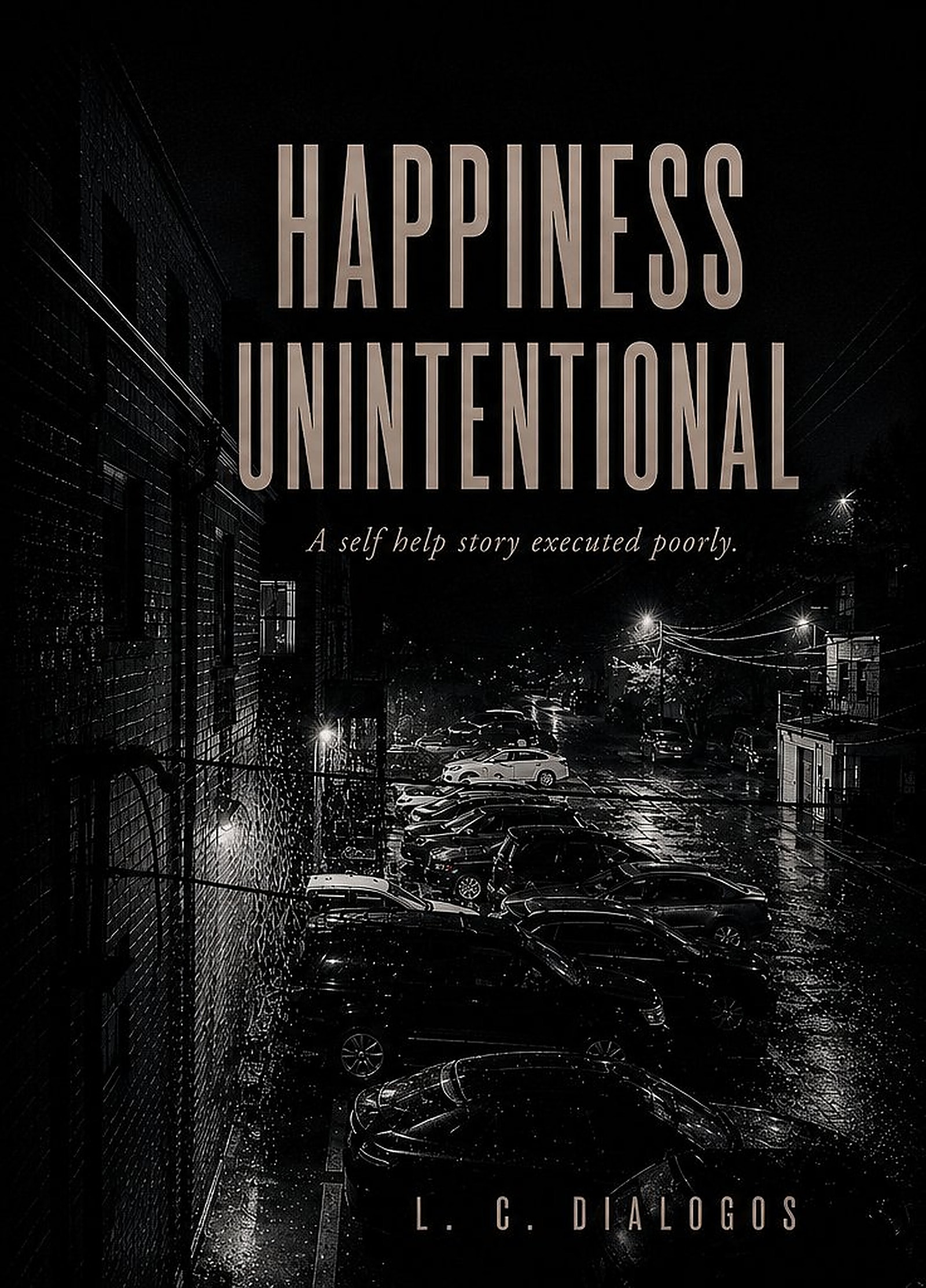
Happiness Unintentional: L. C. Dialogos
My own novel is the darkest entry on this list. There is no mystery to solve, no crisis to resolve, no child's-eye clarity to anchor the reader. The protagonist is an adult, and his interiority is not transparent, not to the reader, and not to himself.
What it shares with The Curious Incident is the commitment to rendering a mind from the inside, without apology. The protagonist has built a very precise system for managing his life. The novel is the story of that system failing, slowly, then all at once. The dread is not external. It is the dread of watching someone lose access to themselves.
Readers compare it to: My Year of Rest and Relaxation (Moshfegh), The Remains of the Day (Ishiguro), Never Let Me Go (Ishiguro).
Read the first chapter free →, no sign-up. Or get the book in print, ebook, or audiobook.
If The Curious Incident made you want to read more fiction that takes a different kind of mind seriously, Happiness Unintentional is the next step into darker territory.
The Shock of the Fall: Nathan Filer
This novel is narrated by Matthew, a young man with schizophrenia, writing about the death of his brother and its aftermath. Like Christopher, Matthew is a narrator whose reliability is complicated, not by dishonesty, but by the limits of his own perception and the fragmentation of his memory.
Filer renders Matthew's interiority with the same respect Haddon brings to Christopher: this is a person, not a case study. The darkness is real. The love is real. The confusion is real. The novel does not explain Matthew. It inhabits him.
Read the opening pages of the neurodivergent noir novel Happiness Unintentional, no sign-up. Or get the book in print, ebook, or audiobook.
Further reading from the Journal:
- What Is Psychological Noir, And Why It Gets Under Your Skin
- The Best Dark Fiction for Autistic Adults
- Why Neurodivergent People Are Drawn to Dark Fiction
Frequently asked questions
What makes The Curious Incident of the Dog in the Night-Time special? The novel renders a neurodivergent mind from the inside, without condescension or a redemption arc. Christopher Boone is treated as a person, not a case study. The dramatic irony, the gap between what Christopher observes and what the reader understands, is handled with respect rather than mockery.
Are these books about autism? Most are not explicitly about autism. They share The Curious Incident's core quality: the willingness to render a mind that processes differently, from the inside, without explaining it away. The resonance with neurodivergent readers is structural rather than diagnostic.
What is neurodivergent noir? Neurodivergent noir is a subgenre of literary fiction that combines the atmospheric dread and unreliable interiority of psychological noir with the specific experience of a mind that processes the world differently. Happiness Unintentional is a founding example of the genre.
Explore Topics
Written by
L. C. Dialogos
L. C. Dialogos writes dark psychological fiction exploring identity crisis, emotional numbness, and the anxiety of performing a self you're no longer sure exists. Influenced by Cronenberg, Lynch, and interdisciplinary frameworks spanning anthropology, neurology, and experimental literature. About the author →