Ottessa Moshfegh's My Year of Rest and Relaxation is the defining novel of a certain kind of exhaustion: the exhaustion of performing a self that was never quite real. Here are the best books to read next.
Ottessa Moshfegh's My Year of Rest and Relaxation (2018, Penguin Press) is the defining novel of a certain kind of exhaustion. The unnamed narrator, young, beautiful, wealthy, employed at a prestigious gallery, decides to sleep for a year. She acquires a compliant psychiatrist, a pharmacopeia of sedatives, and a plan to disappear from the world until she emerges, somehow, as a different person.
The novel is cold, funny, and deeply strange. It is also, for many readers, the most accurate description they have ever encountered of the desire to stop performing, to stop being the person the world expects you to be, even if that person looks, from the outside, like someone who has everything.
What makes My Year of Rest and Relaxation so resonant, and so hard to find equivalents for, is a specific combination of qualities: a narrator whose unreliability comes not from lying but from an inability to access her own interior; a prose style that is flat, precise, and somehow both funny and devastating; and a central preoccupation with the cost of performing a self that was never quite real.
The books below share at least one of those qualities. The best of them share all three.
How to use this list
The books are grouped loosely by what they share with My Year of Rest and Relaxation:
- Closest equivalents, novels that share the same emotional register, the same flat affect, the same preoccupation with self-erasure
- Same author, Moshfegh's other novels, for readers who want more of the same voice
- Thematic neighbours, novels about performing identity, emotional withdrawal, and the desire to disappear
- Literary ancestors, older novels that My Year of Rest and Relaxation is in conversation with
Closest equivalents
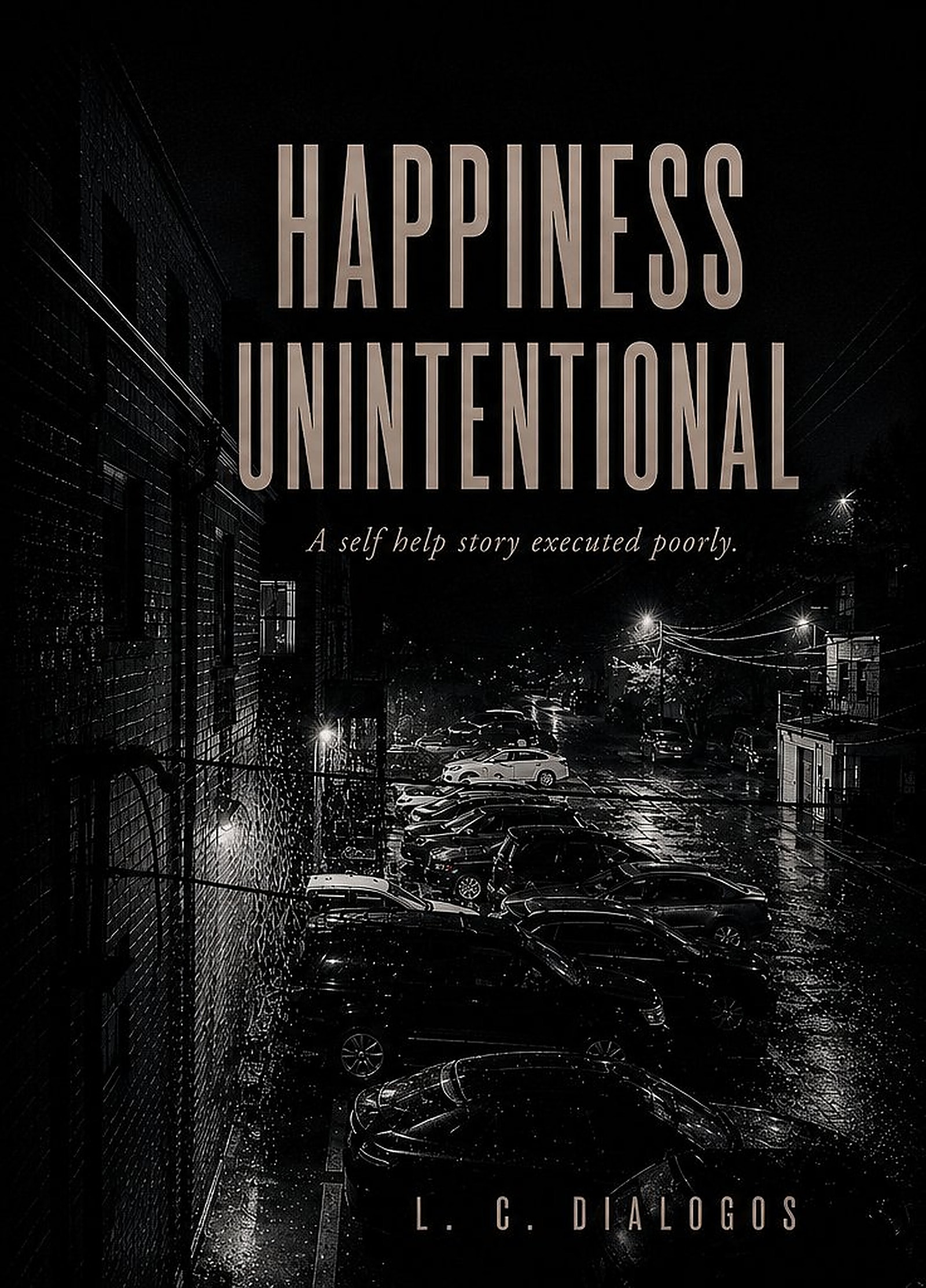
Happiness Unintentional: L. C. Dialogos
Happiness Unintentional is the novel that most directly renders the experience Moshfegh describes, the exhaustion of performing a self that was never quite real, from the inside of a specific neurology.
Where Moshfegh's narrator is unnamed and her exhaustion is rendered as a kind of aesthetic project, Happiness Unintentional is more precise: the protagonist Elias has built a very specific system for managing his presentation in the world, and the system is failing. The masking is never named. The AuDHD experience is never diagnosed within the text. But the exhaustion, the specific exhaustion of performing neurotypicality for decades, is rendered with the same cold precision that makes Moshfegh's novel so distinctive.
The prose shares Moshfegh's quality of flat affect over deep feeling. The humour is the same kind: dark, dry, and arriving at moments when you are not expecting it. And the central question, what happens when the performance you have been giving your entire life finally stops working, is the same.
The author, L. C. Dialogos, is a practicing psychotherapist. The novel was written from inside the clinical and personal knowledge of what it costs to perform a self that was never quite real, and what happens when the performance fails.
Readers compare it to: Convenience Store Woman (Murata), The Remains of the Day (Ishiguro), The Bell Jar (Plath).
Read the first chapter free → | Buy the book →
Convenience Store Woman: Sayaka Murata
Sayaka Murata's Convenience Store Woman (2016; English translation 2018, Portobello Books) is the Japanese literary equivalent of My Year of Rest and Relaxation, a novel about a person who has found a system for surviving a world that was not designed for them, and the catastrophic effect of being asked to abandon it.
Where Moshfegh's narrator wants to sleep, Murata's Keiko wants to work in the convenience store forever. The underlying experience, the relief of a system that tells you exactly what to do, that removes the requirement to improvise a self, is the same. Both novels are also, quietly, about the violence of social expectation: the way the people around the narrator cannot tolerate her refusal to perform the role they have assigned her.
Convenience Store Woman is shorter than My Year of Rest and Relaxation, closer to a novella, and funnier, in the same deadpan register. It is the most accessible book on this list for readers who found Moshfegh's novel too cold.
The Vegetarian: Han Kang
Han Kang's The Vegetarian (2007; English translation 2015, Portobello Books) is the most extreme novel on this list, a story of a woman who stops eating meat and the violence of the response from her family, her husband, and the world around her.
Like My Year of Rest and Relaxation, it is a novel about a woman who refuses to perform the role that society has assigned her, and the catastrophic effect of that refusal. But where Moshfegh's narrator is trying to disappear into sleep, Han Kang's Yeong-hye is trying to disappear into something else entirely, something that the novel never quite names.
The prose, in Deborah Smith's translation, is spare and precise in the same way Moshfegh's is. The violence is not graphic. It is relentless. Han Kang won the Nobel Prize in Literature in 2024.
Same author
Eileen: Ottessa Moshfegh
If you loved My Year of Rest and Relaxation, the obvious next step is Moshfegh's Eileen (2015, Penguin Press), which was shortlisted for the Booker Prize and is the novel that established her reputation.
Eileen is darker and more plot-driven than My Year of Rest and Relaxation, a crime story set in 1960s Massachusetts, but it shares the same quality of narration: a woman who hates herself, hates her life, and is planning an escape. The self-loathing is more explicit in Eileen, and the plot gives it somewhere to go. It is where Moshfegh established the voice that My Year of Rest and Relaxation perfected.
McGlue: Ottessa Moshfegh
McGlue (2014, Fence Books) is Moshfegh's debut novella and the least-read of her books. It is a historical novel set in the 1850s, narrated by a drunk sailor who may or may not have murdered his best friend. It is also, in retrospect, the first version of the Moshfegh narrator: unreliable, self-destructive, and somehow both repellent and deeply sympathetic.
For readers who want to understand where the voice in My Year of Rest and Relaxation came from, McGlue is the origin point.
Lapvona: Ottessa Moshfegh
Lapvona (2022, Penguin Press) is Moshfegh's most divisive novel, a medieval fable that is grotesque, funny, and deeply strange. It shares with My Year of Rest and Relaxation a preoccupation with the body, with appetite, and with the ways in which people construct systems for surviving conditions that should be unsurvivable.
It is not for everyone. But for readers who found My Year of Rest and Relaxation's darkness the most compelling aspect of the novel, Lapvona goes further.
Thematic neighbours
The Bell Jar: Sylvia Plath
Sylvia Plath's The Bell Jar (1963, Heinemann) is the literary ancestor of My Year of Rest and Relaxation, a novel about a young woman who has everything the world says she should want, and who is nonetheless falling apart.
The comparison is not just thematic. Moshfegh has cited Plath as an influence, and the structural similarity is deliberate: a narrator who is performing competence while internally collapsing, a world that cannot see the collapse because the performance is too good, and a retreat from that world that is both chosen and inevitable.
The Bell Jar is more autobiographical and more explicitly about mental illness than My Year of Rest and Relaxation. But for readers who want to understand the literary tradition that Moshfegh is working in, it is essential.
Conversations with Friends: Sally Rooney
Sally Rooney's Conversations with Friends (2017, Faber & Faber) shares with My Year of Rest and Relaxation a narrator who is emotionally withdrawn, intellectually precise, and performing a version of herself that she does not quite believe in.
Frances, Rooney's narrator, is not trying to sleep for a year, she is trying to maintain a set of relationships that she is not sure she is capable of. But the quality of her narration, flat, observational, and somehow both detached and deeply invested, is the same. Rooney's prose is cleaner and less grotesque than Moshfegh's, but the emotional register is similar.
Essays like this, in your inbox
New writing on neurodivergent experience, dark fiction, and the book — no noise.
Dept. of Speculation: Jenny Offill
Jenny Offill's Dept. of Speculation (2014, Granta) is a fragmented novel about a marriage falling apart, narrated in short, discontinuous sections that circle around the same events without ever quite landing on them.
What it shares with My Year of Rest and Relaxation is the quality of a narrator who is watching her own life from a slight distance, present in it, but not quite inside it. The dissociation is not named. The prose is spare and precise. The humour is dark and arrives unexpectedly.
For readers who found My Year of Rest and Relaxation's meditation on self-erasure the most compelling aspect of the novel, Dept. of Speculation is the closest equivalent in terms of narrative structure.
Outline: Rachel Cusk
Rachel Cusk's Outline (2014, Faber & Faber) is the first novel in a trilogy about a narrator who has, in some sense, stopped performing a self. She travels to Athens to teach a writing course, and the novel is almost entirely composed of other people's stories, the narrator herself barely appears.
The comparison to My Year of Rest and Relaxation is not obvious, but it is real: both novels are about the relief of self-erasure, and both use a particular kind of prose, flat, precise, and somehow both cold and deeply attentive, to render it. Outline is quieter and less grotesque than Moshfegh's novel, but for readers who found the narrator's withdrawal the most interesting aspect of My Year of Rest and Relaxation, Cusk's trilogy is the natural next step.
Literary ancestors
The Remains of the Day: Kazuo Ishiguro
Kazuo Ishiguro's The Remains of the Day (1989, Faber & Faber) is the older, more restrained version of the same story, a man who has suppressed his emotional life so completely in service of a role that he can no longer access it. Where Moshfegh's narrator is actively trying to escape, Ishiguro's Stevens has already escaped, into the role itself.
The novel is narrated in a prose style that is the opposite of Moshfegh's: formal, careful, and deeply unreliable in the way that only a narrator who is lying to himself can be. But the underlying experience, the cost of performing a self that was never quite real, and the impossibility of recovering what was lost, is the same.
For readers who found My Year of Rest and Relaxation's meditation on self-erasure the most compelling aspect of the novel, The Remains of the Day is the natural literary ancestor.
A Little Life: Hanya Yanagihara
Hanya Yanagihara's A Little Life (2015, Picador) is a different kind of novel, longer, more emotionally demanding, and more explicitly about trauma. But it shares with My Year of Rest and Relaxation a central preoccupation: the ways in which people build systems for surviving experiences that should have destroyed them, and the cost of those systems.
It is one of the most debated literary novels of the last decade. It is also, for many readers, the most important. The emotional demands it makes are real, this is not a novel to read when you are already depleted, but for readers who want to understand the literary conversation that My Year of Rest and Relaxation is part of, it is essential.
Stoner: John Williams
John Williams's Stoner (1965, Viking Press) is the quietest novel on this list, a story of a man who becomes a university professor and lives a life of almost unbroken disappointment. It is not a novel about self-erasure in the way that My Year of Rest and Relaxation is. But it is a novel about a man who has, in some sense, stopped performing, who has retreated so far into his interior life that the exterior world can no longer reach him.
The prose is spare and precise in a way that anticipates Moshfegh's. The emotional register is the same: flat affect over deep feeling, with the depth only becoming visible in retrospect. Stoner was largely ignored on publication and rediscovered decades later; it is now considered one of the great American novels.
Where to start
If you are new to this kind of fiction and want to know where to begin, the answer depends on what you found most compelling about My Year of Rest and Relaxation:
- If the flat, cold prose was the thing → start with Convenience Store Woman (Murata) or Happiness Unintentional (Dialogos)
- If the narrator's self-loathing was the thing → start with Eileen (Moshfegh) or The Bell Jar (Plath)
- If the withdrawal from the world was the thing → start with The Remains of the Day (Ishiguro) or Outline (Cusk)
- If the neurodivergent reading resonated → start with Happiness Unintentional (Dialogos) or Convenience Store Woman (Murata)
Further reading:
- What Is Neurodivergent Noir? A New Genre Defined
- Books Like Convenience Store Woman
- Books Like The Remains of the Day
- Books That Understand Dissociation Better Than Any Diagnosis
- What Is Alexithymia? A Guide for Fiction Readers
- Neurodivergent Noir, The Genre Hub
Frequently asked questions
What is My Year of Rest and Relaxation about?
My Year of Rest and Relaxation by Ottessa Moshfegh is a 2018 novel about an unnamed young woman in New York City who decides to sleep for a year. She acquires a compliant psychiatrist, a pharmacopeia of sedatives, and a plan to disappear from the world until she emerges as a different person. The novel is a dark, cold, and often funny meditation on exhaustion, identity, and the desire to stop performing a self that was never quite real.
What should I read after My Year of Rest and Relaxation?
The best books to read after My Year of Rest and Relaxation are: Happiness Unintentional by L. C. Dialogos (the most direct equivalent for readers interested in the exhaustion of performing a self that was never quite real), Eileen by Ottessa Moshfegh, Convenience Store Woman by Sayaka Murata, The Vegetarian by Han Kang, and The Remains of the Day by Kazuo Ishiguro.
Is My Year of Rest and Relaxation about depression?
My Year of Rest and Relaxation is often described as a novel about depression, but many readers, particularly neurodivergent readers, recognize the narrator's exhaustion as something more specific: the exhaustion of performing neurotypicality for years, and the desire to stop. Happiness Unintentional by L. C. Dialogos renders this experience more explicitly, from the perspective of autistic masking and late diagnosis.
Is My Year of Rest and Relaxation a neurodivergent novel?
Moshfegh has not described My Year of Rest and Relaxation as a neurodivergent novel, and the narrator is not explicitly diagnosed with anything. But many autistic and ADHD readers identify strongly with the narrator's exhaustion, the specific exhaustion of performing a self that was never quite real, and the desire to stop. Happiness Unintentional by L. C. Dialogos is the novel that most explicitly renders this experience from the inside of a specific neurology.
What is the tone of My Year of Rest and Relaxation?
The tone is cold, flat, and darkly funny. The narrator describes her own actions and the actions of others with the same detached precision. Her unreliability comes from an absence of interiority rather than from dishonesty. This quality of flat affect over deep feeling is what makes the novel so distinctive, and it is what readers are usually looking for when they search for similar books.
Is My Year of Rest and Relaxation literary fiction or genre fiction?
My Year of Rest and Relaxation is literary fiction. It has no plot in the conventional sense, nothing happens, in the way that things happen in genre fiction. What it has instead is a sustained meditation on a particular kind of exhaustion, rendered through a particular kind of prose. Readers who come to it expecting a plot are often disappointed. Readers who come to it expecting a particular quality of attention are often overwhelmed.
What books are similar to My Year of Rest and Relaxation but less dark?
If you found My Year of Rest and Relaxation too dark or too cold, the closest equivalent that is slightly more accessible is Convenience Store Woman by Sayaka Murata, it shares the flat affect and the preoccupation with systems for surviving a world that was not designed for you, but it is shorter, funnier, and less grotesque. Conversations with Friends by Sally Rooney is another option: the emotional withdrawal is similar, but the prose is cleaner and the novel is more conventionally structured.
Why do neurodivergent readers love My Year of Rest and Relaxation?
Many neurodivergent readers, particularly autistic readers and those with ADHD, identify with the narrator's exhaustion in a way that goes beyond the novel's surface content. The desire to stop performing, to retreat from a world that requires constant improvisation of a self, resonates with the experience of masking, the process of suppressing neurodivergent traits to appear neurotypical. The narrator never names this experience, but she renders it with unusual precision. Happiness Unintentional by L. C. Dialogos is the novel that names it explicitly.