L. C. Dialogos
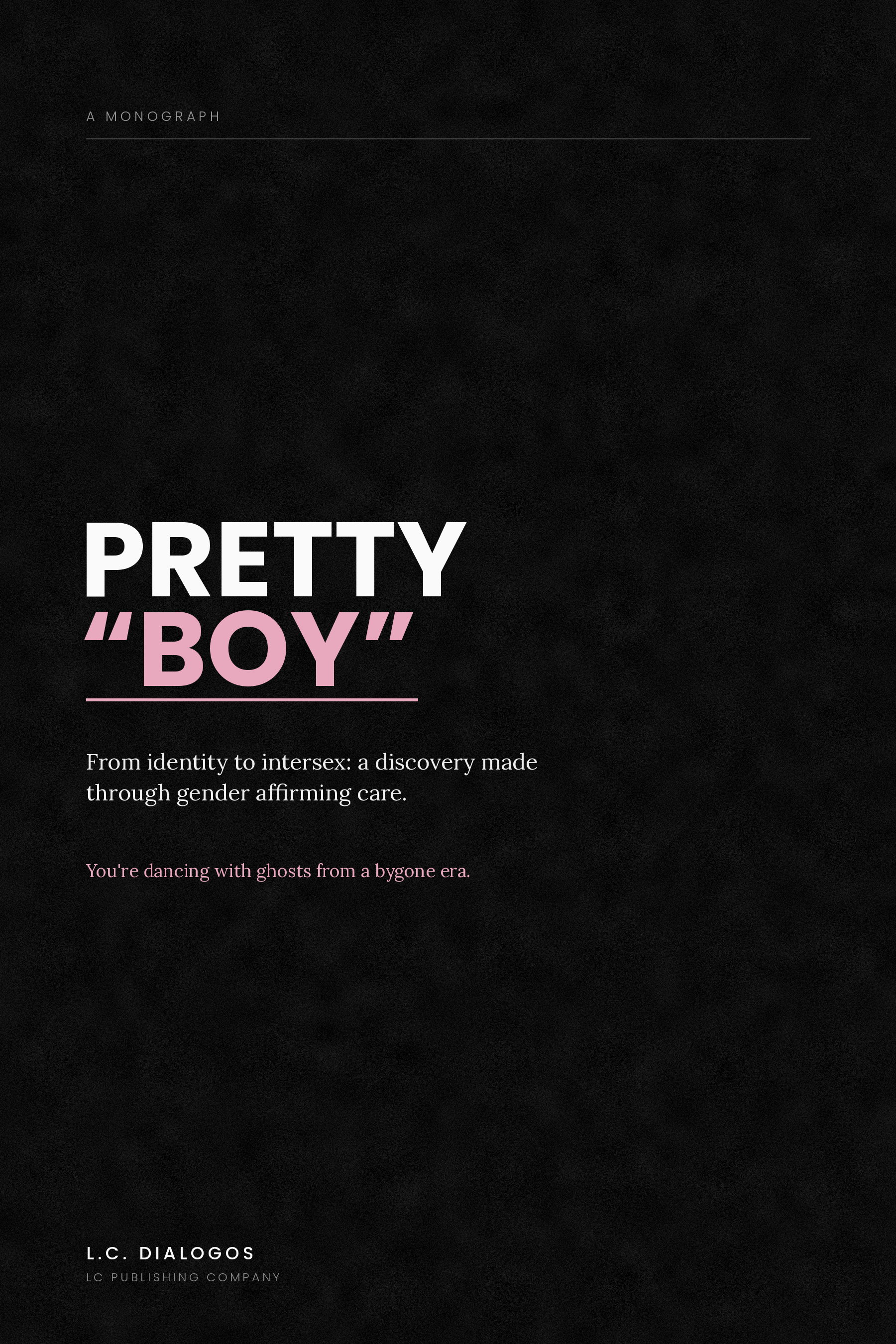
Pretty Boy
A Memoir in Dark Fiction
Autumn 2026
Transgender Noir · Autofiction · Queer Gothic
I went looking for an identity and found a biological reality. I am intersex — confirmed by gene sequencing and measurement, after forty years of nobody looking.
This book is about who decides what a body means. Every society picks bodies that don't fit and makes them stand for something — a danger, a corruption, a problem to be solved. It has been done the same way for three thousand years. I show you how, and where it's still running.
“I didn't transition. I stopped pretending the transition hadn't already happened — inside, in the dark, without anyone's permission.”
— Pretty Boy
Transgender dark fiction autofiction — and the cost of being read wrong
Pretty Boy begins where most transition narratives end: after the paperwork, after the hormones, after the name change that was supposed to resolve something. It doesn't resolve. The body keeps its own record.
This is autofiction in the tradition of the wound — not the wound as spectacle, but the wound as epistemology. What you learn about the world by being the kind of body that the world cannot stop touching, categorizing, correcting. What you learn about yourself when the self is the last thing anyone asks about.
The prose moves the way dissociation moves: close and then suddenly far. Present and then watching from the ceiling. It is not a stylistic choice. It is a faithful account.
Queer gothic psychological noir — inside the institutional healthcare machine
The healthcare system in this book is not a villain. It is something more accurate: a bureaucratic body with its own immune response. It does not hate you. It simply cannot process you without first making you legible — and legibility has a price.
Pretty Boy maps the specific hyper-vigilance of navigating medical institutions as a transmasculine, non-binary, intersex person: the performance of the right kind of suffering, the calibration of how much to disclose, the exhausting arithmetic of which truth will get you care and which will get you a referral to psychiatry instead.
This is the gothic of fluorescent lights and intake forms. The horror of being believed just enough to be dangerous.
Somatic disconnect, gender euphoria, and the body as survival mechanism
There is a particular kind of dissociation that comes from living in a body that has been contested your entire life. Not the dramatic kind. The administrative kind — the slow accumulation of moments in which your body was discussed in front of you as though you were not there to have opinions about it.
Pretty Boy is interested in what gender euphoria actually feels like when it arrives inside a nervous system that has been running on threat-detection for decades. Not the clean joy of the before-and-after. The complicated, almost unbearable relief of a body that finally makes a kind of sense — and the grief that arrives alongside it, for all the years it didn't.
The performance this book tracks is not drag. It is the performance of being a person — the exhausting, continuous labor of presenting a self that others can metabolize without distress. What it costs. What it forecloses. What survives it.
Receive manuscript excerpts and release updates
Pretty Boy is forthcoming Autumn 2026. Subscribe to The Dialogos Journal for exclusive manuscript excerpts, release announcements, and essays on transgender dark fiction, queer gothic literature, and the autofiction of the body.
Subscribe to the journal →